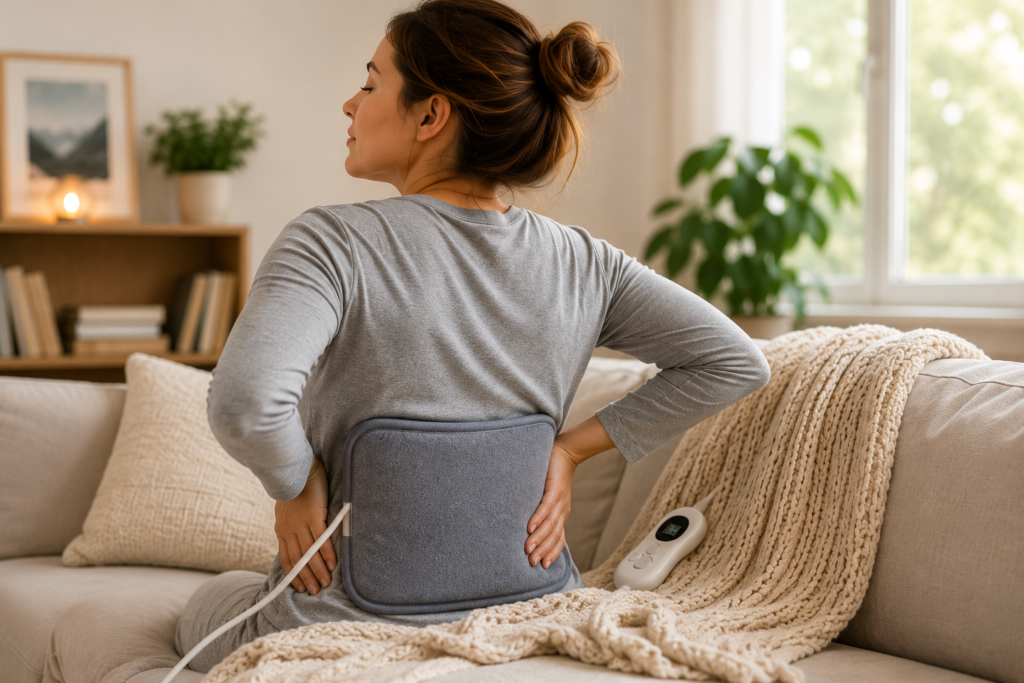
Can you use a heating pad too much? Learn common heat therapy mistakes, warning signs of overuse, safer heating pad habits, and when to stop using heat.
A heating pad can feel wonderful when your lower back is stiff, tight, or achy. The warmth may help relax tense muscles and make it easier to move comfortably.
But can you use a heating pad too much?
Yes. It is possible to overdo heat therapy. Using a heating pad for excessively long periods, choosing a temperature that is too hot, falling asleep with it, or repeatedly applying heat to irritated skin can increase the risk of burns and skin damage.
Heat also isn’t appropriate for every type of back pain. If your discomfort follows a new injury, involves significant swelling, or is accompanied by concerning symptoms, repeatedly applying more heat may not be the right approach.
The goal isn’t to avoid heating pads altogether. It’s to understand when heat may help, when you’ve had enough, and when your back pain needs something other than another heating-pad session.
Key Takeaways
- Heat may temporarily ease muscle tightness and stiffness.
- More heat does not necessarily mean more relief.
- Follow the timing and temperature instructions provided with your particular heating pad.
- Avoid placing very hot heating devices directly against bare skin.
- Don’t fall asleep while using a heating pad unless the product is specifically designed and instructed for that type of use.
- Stop if your skin becomes painful, unusually red, blistered, mottled, or irritated.
- Heat shouldn’t become a substitute for appropriate movement, posture changes, or medical evaluation.
- New, severe, persistent, or worsening back pain deserves professional attention.
Why Heating Pads Can Feel So Good on an Aching Back
Heat therapy is popular for a simple reason: warmth can be comforting.
When muscles around your lower back feel tight, gentle heat may promote relaxation and temporarily reduce the sensation of stiffness. That can be particularly appealing after sitting at a desk, driving for a long time, or completing an activity that leaves your muscles feeling tense.
For some people, heat also makes gentle movement feel easier.
That doesn’t mean the heating pad is fixing the underlying cause of the pain, however.
If your back hurts because you sit for hours without changing positions, for example, heat may temporarily make you more comfortable while the sitting pattern that contributes to your discomfort remains unchanged.
If prolonged sitting is one of your biggest triggers, read:
Why Lower Back Pain Gets Worse After Sitting
Can You Use a Heating Pad Too Much?
Yes, especially when duration, temperature, skin exposure, or frequency exceed what is appropriate for you and the particular product you’re using.
One of the easiest mistakes to make is assuming:
“If a little heat feels good, keeping it on longer must feel even better.”
That’s not necessarily true.
Your skin continues to receive heat even after you become accustomed to the sensation. A temperature that initially feels pleasant may become irritating with prolonged exposure.
Repeated exposure can also cause changes in the appearance of the skin. Chronic exposure to a heat source can sometimes produce a persistent mottled or net-like discoloration known as erythema ab igne.
A heating pad is therefore best treated as a temporary comfort tool, not something that should remain against your back indefinitely.
Signs You May Be Overdoing Heat Therapy
Your body and skin can give you clues that it’s time to stop.
Pay attention to:
- Skin that becomes increasingly red
- Burning, stinging, or tenderness
- Blistering
- Persistent mottled or net-like discoloration
- Numbness or unusual changes in sensation
- Pain that feels worse during or after using heat
- Feeling as though you need the heating pad constantly just to get through normal activities
A little temporary warmth or mild pinkness isn’t necessarily the same as a burn, but painful, persistent, or worsening skin changes shouldn’t be ignored.
Stop using the heating pad if something doesn’t feel right.
7 Common Heating Pad Mistakes to Avoid
1. Leaving the Heating Pad on for Too Long
There isn’t one universal heating-pad time limit that applies to every device and every person.
Different products produce different temperatures and have different manufacturer instructions. Some include automatic shutoff features, while others don’t.
Use the manufacturer’s directions for your specific heating pad rather than assuming longer sessions are better.
If you are unsure how long you should use heat, start conservatively and discuss your situation with a healthcare professional.
2. Turning the Temperature Up Too High
A heating pad does not need to feel extremely hot to provide warmth.
Turning it to the highest setting because your back hurts more can increase your risk of skin injury.
Use a comfortable setting and check your skin periodically. If the pad feels painfully hot, causes burning, or makes your skin uncomfortable, stop.
Pain relief should never require tolerating burning heat.
3. Falling Asleep With a Heating Pad
This is one of the most important mistakes to avoid.
When you’re asleep, you aren’t reliably monitoring:
- How hot your skin feels
- How long the heat has been applied
- Whether the pad has shifted
- Whether irritation is developing
An automatic shutoff feature can add an extra layer of protection, but it doesn’t mean every heating pad is intended for use while sleeping.
A safer habit is to use warmth before bed while you’re awake, following your product’s directions, and remove the heating pad before going to sleep unless its manufacturer specifically says otherwise.
4. Putting Excessive Heat Directly Against Bare Skin
A very hot heating device directly against your skin can increase your risk of burns.
Follow the manufacturer’s instructions regarding clothing, covers, or barriers. Many heating products are designed with a cover or are intended to be used over clothing.
Never assume hotter skin contact will produce faster healing.
5. Using Heat on Every Type of Back Pain
Not all back pain is caused by tight muscles.
If you’ve just injured yourself and the area is swollen, warm, bruised, or acutely inflamed, heat may not be your best first choice.
Heat and cold are used for different reasons depending on the situation.
The cause of your pain matters much more than simply choosing whichever treatment feels most comforting.
6. Ignoring Your Skin
It’s easy to focus entirely on your back pain and forget about the skin underneath the heating pad.
Check your skin periodically.
This is especially important for anyone who has reduced temperature sensation or numbness, because they may not notice excessive heat as quickly.
People with conditions that affect sensation or circulation should ask a healthcare professional whether heating-pad use is appropriate for them.
7. Using Heat Instead of Addressing the Bigger Problem
Suppose your back becomes painful every afternoon after six hours at a computer.
A heating pad might make the muscles feel better temporarily. But if you return to the same chair, same posture, and same uninterrupted sitting routine every day, you’re missing an opportunity to address an important trigger.
Heat works better as one part of a broader comfort routine.
That might include:
- Changing positions regularly
- Taking short walking breaks
- Improving your workstation
- Using appropriate lumbar support
- Gentle movement
- Gradually improving strength and mobility when appropriate
- Seeking professional care when pain persists
If sitting is contributing to your discomfort, see:
How to Sit Without Lower Back Pain
When Heat May Be Helpful for Back Pain
Gentle heat is commonly used when discomfort feels related to:
- Muscle tightness
- Stiffness
- Tension after prolonged sitting
- Chronic achiness
- Muscles that feel tight before gentle movement
Think about how the discomfort feels rather than automatically reaching for the heating pad every time your back hurts.
If warmth makes your muscles feel more relaxed and movement more comfortable without irritating your skin or worsening your symptoms, it may be a useful part of your routine.
When You Should Be More Cautious With Heat
Heat deserves extra caution when:
- The injury is very recent
- Significant swelling is present
- The area is already hot or inflamed
- Your skin is damaged or irritated
- You have reduced sensation in the area
- You have a condition that affects circulation
- You cannot reliably feel how hot the pad is
- Heat consistently makes your symptoms worse
When you’re uncertain whether heat is appropriate for your particular medical situation, ask a healthcare professional.
What About Heat Versus Ice?
People often ask whether back pain needs heat or ice.
Unfortunately, there isn’t a single answer that works for every situation.
Heat is commonly chosen for stiffness and muscle tension.
Cold therapy is commonly used for certain acute injuries, swelling, or soreness shortly after an injury.
But your symptoms, medical history, and cause of pain matter.
Instead of automatically switching between heat and ice according to a rigid schedule, pay attention to what happened, what symptoms you have, and whether professional evaluation is needed.
A Safer Way to Use a Heating Pad
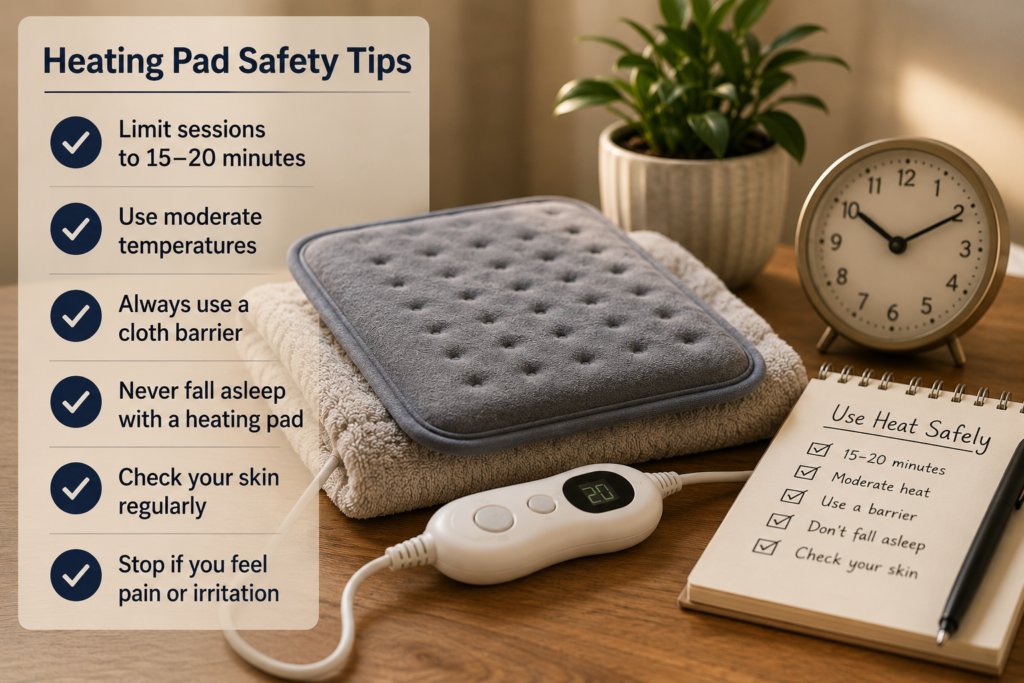
Before your next session, run through this quick safety check.
Before You Start
Make sure:
- The heating pad isn’t damaged.
- The cord and controller appear intact.
- Your skin isn’t already irritated.
- You can clearly feel temperature in the treatment area.
- You’re awake and able to monitor the session.
While Using It
- Follow your heating pad’s temperature and timing instructions.
- Choose comfortable warmth rather than maximum heat.
- Position the pad according to the manufacturer’s directions.
- Check how your skin feels.
- Stop if you experience burning, pain, numbness, or unusual irritation.
Afterward
Remove the pad and give your skin time away from the heat.
Then ask yourself:
Did the heat actually help?
If you’re repeatedly using the heating pad but your pain continues returning unchanged—or is becoming worse—the answer probably isn’t simply another heat session.
Don’t Forget Movement
Back pain can make you want to stay still, but prolonged inactivity can contribute to stiffness for many people.
When appropriate for your condition, gentle movement may complement the temporary comfort you get from heat.
That doesn’t mean forcing painful stretches.
Something as simple as standing up, walking briefly, or changing positions can be a reasonable starting point.
If your muscles feel more comfortable after warming up, you might find gentle movement easier afterward. Stop any activity that causes significant or worsening pain.
Improve the Habits That May Be Contributing to Your Pain
A heating pad can only do so much.
Consider what happens during the rest of your day.
If You Sit for Long Periods
Try changing positions regularly instead of remaining seated for hours.
Keep your feet supported, avoid repeatedly leaning to one side, and arrange your workstation so you aren’t constantly reaching or bending forward.
If You Wake Up Stiff
Look at your sleep position and nighttime support.
Morning stiffness can have several causes, and your sleep setup is only one factor, but improving alignment and avoiding awkward positions may make rest more comfortable.
You can learn more here:
Why Lower Back Pain Is Worse in the Morning
If Your Back Is Constantly Tight
Repeated muscle tightness may be a sign that you need more than temporary symptom relief.
Your healthcare provider or physical therapist can help identify whether strength, mobility, posture, work habits, or another issue may be contributing.
Choosing a Heating Pad for Safer Home Use
If you regularly use heat therapy, certain features can make a heating pad easier to control.
Consider looking for:
- Multiple temperature settings
- Automatic shutoff
- A clear, easy-to-use controller
- A flexible pad that comfortably fits the intended area
- A removable/washable cover if appropriate
- Clearly written safety and care instructions
You don’t necessarily need the hottest or most expensive model.
Control, comfort, and appropriate safety features are more important than maximum temperature.
For more help choosing one, read:
Best Heating Pads for Lower Back Pain
When Back Pain Needs Medical Attention
A heating pad is intended for temporary comfort. It shouldn’t delay medical care when symptoms could indicate something more serious.
Seek prompt medical attention if back pain is accompanied by symptoms such as:
- New bowel or bladder control problems
- Numbness around the groin or saddle area
- Significant or worsening weakness
- Severe pain after a major fall, accident, or injury
- Fever or feeling seriously unwell along with back pain
- Severe or rapidly worsening symptoms
You should also consider speaking with a healthcare professional when pain persists, repeatedly returns, interferes with normal activities, or isn’t improving as expected.
Frequently Asked Questions
Can you use a heating pad too much?
Yes. Excessive duration, excessive temperature, repeated exposure, or using heat despite skin irritation can cause problems. Follow the instructions for your particular heating pad and stop if your skin becomes painful, irritated, blistered, or unusually discolored.
How long should you use a heating pad?
There isn’t one perfect time limit for every heating pad and every person. Follow the manufacturer’s directions for your device and any guidance provided by your healthcare professional.
Can you use a heating pad every day?
Some people use heat regularly for muscle stiffness, but daily use doesn’t automatically make it appropriate for every condition. Make sure you’re following the product instructions, protecting your skin, and addressing the reason your discomfort keeps returning.
Can a heating pad make back pain worse?
It can in some circumstances. Heat may be inappropriate for certain acute injuries or swelling, and excessive heat can irritate or burn the skin. If your symptoms consistently worsen after heat, stop using it and consider medical guidance.
Is it safe to sleep with a heating pad?
Falling asleep can make it difficult to monitor temperature, duration, and your skin’s reaction. Follow the manufacturer’s warnings for your device and, unless it is specifically intended for such use, remove it before falling asleep.
Should I use the highest setting when my back really hurts?
No. More heat doesn’t necessarily provide better relief, and excessive temperature increases the risk of burns. Use a comfortable setting according to the manufacturer’s instructions.
Final Thoughts
A heating pad can be a simple and comforting tool for tight, stiff back muscles—but more isn’t always better.
Use heat thoughtfully. Follow the instructions that came with your device, choose comfortable warmth instead of extreme heat, pay attention to your skin, and don’t allow temporary relief to distract you from persistent or worsening pain.
Most importantly, think of heat therapy as one tool in your overall back-comfort routine, not the entire solution.
Movement, posture, sleep habits, appropriate exercise, and professional care when needed all matter too.
If your heating pad helps you feel comfortable enough to move a little easier and continue your day, that’s a useful role for it. If you find yourself needing heat constantly while your symptoms continue to worsen, that’s a sign to look beyond the heating pad and find out what may be driving the pain.
PathwayToRelief.com provides general educational and wellness information only. This content is not intended to diagnose, treat, cure, or prevent any medical condition and is not a substitute for individualized medical advice, diagnosis, or treatment from a qualified healthcare professional. If you have persistent, severe, worsening, or concerning symptoms, seek appropriate medical care.
PathwayToRelief.com may contain affiliate links. If you purchase a product through one of these links, we may earn a commission at no additional cost to you. Product mentions are provided for informational purposes and should not be considered medical recommendations.