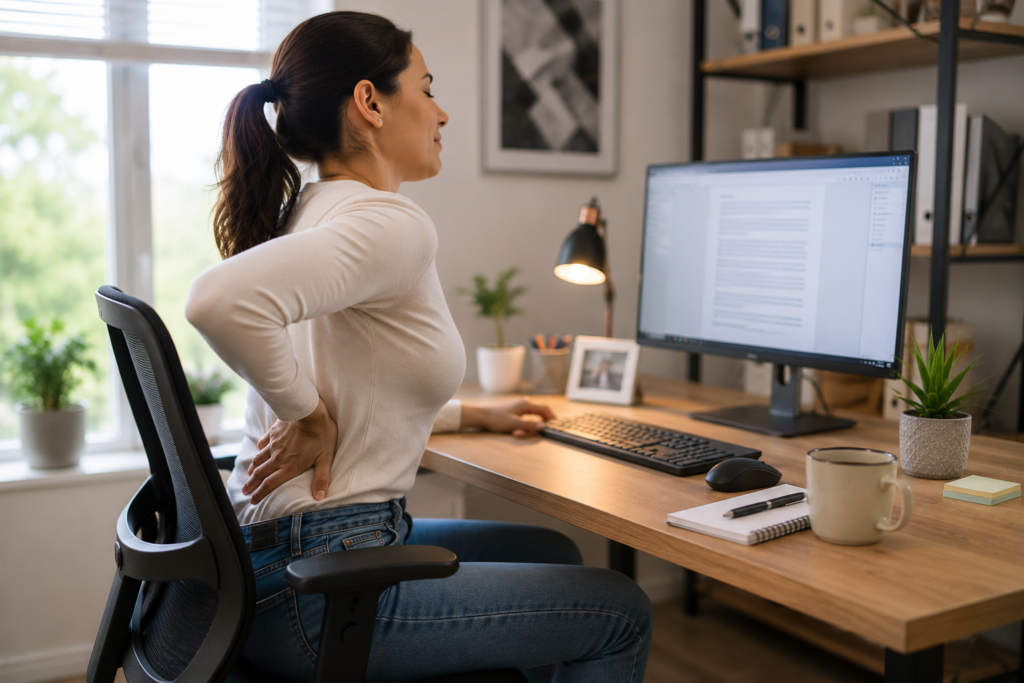
Lower back pain getting worse after sitting? Learn why prolonged sitting may contribute to stiffness, how your workstation affects comfort, and practical changes that may help.
Category: Pain Relief Education
If your lower back feels fine when you first sit down but becomes increasingly stiff or uncomfortable as the day goes on, you’re certainly not the only person who notices this pattern.
Desk work, long drives, computer use, gaming, and even relaxing on the couch can keep your body in one position for extended periods.
But sitting itself isn’t necessarily the enemy.
For many people, discomfort may have more to do with staying in the same position for too long, an uncomfortable workstation, reduced movement during the day, or an existing back problem that becomes more noticeable while sitting.
Understanding those factors can help you make sensible changes without obsessing over achieving a single “perfect” posture.
Key Takeaways
- Sitting isn’t automatically harmful to your back.
- Staying in one position for a long time may contribute to stiffness and discomfort.
- Your chair, desk, screen position, and daily movement habits can affect comfort.
- There is no single perfect posture you must maintain all day.
- Regular position changes may be more practical than trying to sit perfectly for hours.
- Gentle movement can help some people feel less stiff after prolonged sitting.
- Persistent, severe, worsening, or neurologic symptoms should be evaluated by a healthcare professional.
Why Can Lower Back Pain Feel Worse After Sitting?
There isn’t one explanation that applies to everyone.
Your lower back works together with muscles, joints, nerves, connective tissues, hips, and the rest of your body. Sitting changes how some of these structures are loaded compared with standing or walking.
That doesn’t mean sitting is damaging your spine every time you take a seat.
The problem may arise when you spend a long period in a position that becomes uncomfortable and don’t give your body opportunities to move.
Think about a typical workday.
You might begin sitting comfortably at 8:00 a.m. As you become focused on your work, you gradually slide forward, lean toward the monitor, cross your legs, or remain almost completely still.
An hour later, your back feels different.
That doesn’t necessarily mean you’ve injured yourself. Your body may simply be telling you that it’s ready for a change of position.
Staying in One Position Can Contribute to Stiffness
One important distinction is the difference between sitting and prolonged sitting without much movement.
Your body is designed to move through many positions throughout the day.
When you’re absorbed in computer work, however, several hours can pass surprisingly quickly.
During that time, you might move very little.
Eventually, muscles around your lower back, hips, and legs may begin to feel stiff or uncomfortable.
That’s one reason standing up after a long work session can initially feel awkward.
For some people, taking a short walk or simply changing positions feels good because the body finally gets some variety.
If you’re looking specifically for practical steps to take after a long sitting session, see:
Lower Back Pain After Sitting Too Long? What to Do and How to Prevent It
That article is our practical action guide, while this one focuses on understanding why the pattern can occur.
Your Sitting Position Can Affect Comfort
You’ve probably heard that “bad posture” causes back pain.
The reality is more nuanced.
Posture isn’t simply divided into one good position and one bad position.
People naturally sit differently depending on their body, chair, activity, and comfort level.
The bigger question is:
Can you sit comfortably, and are you changing positions throughout your day?
Certain positions may become uncomfortable when maintained for long periods.
For example, you may notice discomfort when you repeatedly:
- Lean far forward toward your monitor
- Sit unsupported on the edge of your chair
- Twist toward one side
- Reach repeatedly for your mouse or keyboard
- Work with your screen positioned awkwardly
- Stay in one position for hours
Instead of becoming anxious about maintaining “perfect posture,” focus on comfortable support and regular movement.
Slouching Isn’t Something You Need to Fear
Slouching is often portrayed as something you should never do.
But people naturally move through relaxed and upright positions.
A brief period of slouching isn’t automatically damaging.
The problem may be remaining in any uncomfortable position for a long time, especially when you already have a sensitive back.
If you notice yourself becoming uncomfortable, use that as a reminder to reposition yourself.
Sit back.
Adjust your chair.
Stand for a little while.
Walk around.
Then return to whatever position feels comfortable.
Your Chair May Not Be Supporting You Well
Your chair can make prolonged computer work either more or less comfortable.
A chair that doesn’t fit your body may leave you constantly adjusting yourself.
Consider:
- Can your feet reach the floor or another stable surface?
- Is the seat comfortable?
- Can you sit back against the chair?
- Does your lower back feel adequately supported?
- Are your armrests interfering with your desk?
- Does the chair encourage you to reach forward constantly?
You don’t necessarily need an expensive ergonomic chair.
Sometimes a simple adjustment in seat height, desk position, or lumbar support makes the workspace considerably more comfortable.
For detailed sitting guidance, read:
How to Sit Without Lower Back Pain
Your Computer Setup Can Make You Lean Forward
Sometimes what looks like a posture problem is actually an equipment problem.
For example, imagine that your laptop screen is small and positioned far away.
Without realizing it, you may gradually lean toward it.
Or perhaps your mouse is too far from your body, causing you to reach forward repeatedly.
Look at your entire workstation rather than focusing only on your spine.
Monitor
Position your screen where you can view it comfortably without repeatedly craning your neck or leaning your torso forward.
Keyboard and Mouse
Keep frequently used equipment within comfortable reach.
Your shoulders shouldn’t have to remain tense simply to use your computer.
Feet
Give your feet a stable surface.
If your chair must be raised to accommodate your desk and your feet no longer comfortably reach the floor, an appropriate footrest may help.
Lower-Back Support
If additional lumbar support feels comfortable, experiment with your chair’s built-in adjustment or an appropriately sized cushion.
These changes aren’t about forcing your body into one rigid position.
They’re about making your workstation fit you better.
Movement May Matter More Than Perfect Posture
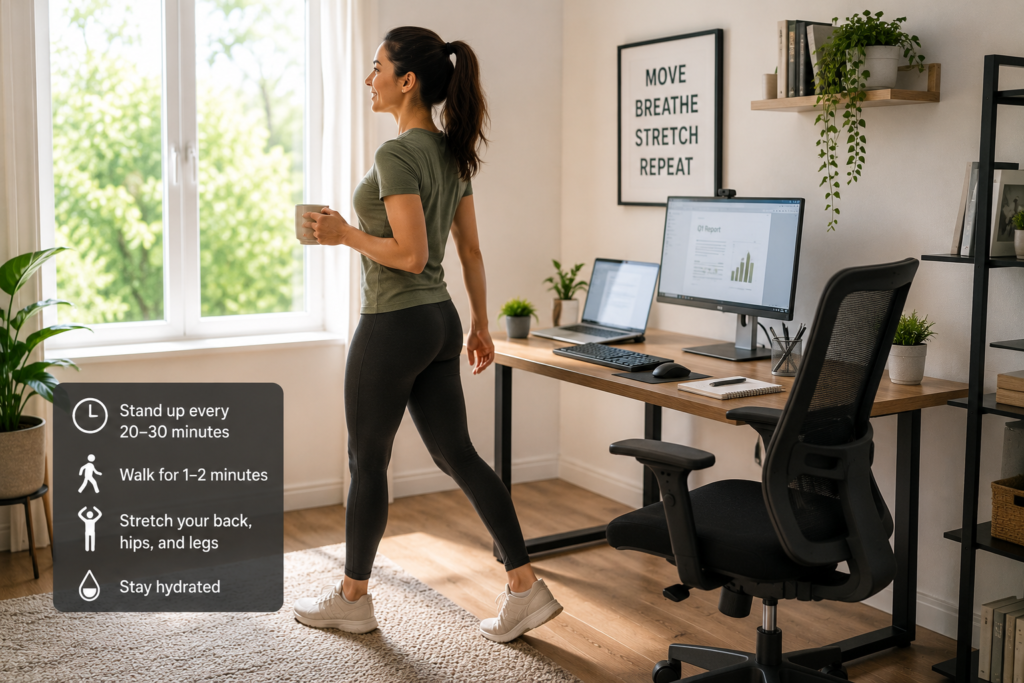
Here’s one of the most useful concepts for desk workers:
Your next position may be more important than your perfect position.
You could have a fantastic ergonomic chair and still become uncomfortable if you sit in it continuously for hours.
Try introducing more variety.
You might:
- Sit comfortably for a while
- Lean back
- Stand during a phone call
- Walk to refill your water
- Work standing briefly
- Sit again
- Take a short walk at lunch
You don’t need to turn every break into an exercise routine.
Simply moving more frequently can provide your body with a change from prolonged sitting.
Do You Need to Stand Every 20 or 30 Minutes?
The old version of this article recommended a strict “20-minute movement rule.”
I’m removing that.
There isn’t a magical minute at which sitting suddenly becomes harmful for everyone.
A rigid schedule can also make people feel like they’re doing something wrong if they can’t leave their workstation every 20 minutes.
Instead, find realistic opportunities to change positions during your day.
For example:
- Between phone calls
- After finishing an email task
- When getting water
- During bathroom breaks
- Between meetings
- At lunch
- When you notice yourself becoming stiff
If a reminder helps you avoid losing track of time, you can certainly use one.
Just don’t treat the timer as a medical rule.
Why Your Hips May Feel Tight After Sitting
People who sit for long periods often describe their hips as “tight.”
That sensation can be uncomfortable when you first stand.
Rather than assuming something is structurally wrong, begin with gentle movement.
A short walk may feel good.
Some people also enjoy comfortable hip and lower-body mobility exercises.
Avoid aggressively stretching because you believe you need to “undo” hours of sitting.
Movement should feel controlled and appropriate for your abilities.
If an exercise produces sharp pain or significantly worsens your symptoms, stop.
Can Weak Core Muscles Cause Sitting-Related Back Pain?
You’ll often hear that back pain means you have a “weak core.”
That’s too simplistic.
Strength can certainly be an important part of physical function, but back pain has many potential contributing factors.
Simply doing hundreds of abdominal exercises isn’t guaranteed to solve your pain.
A more balanced approach may include appropriate:
- General physical activity
- Strength training
- Mobility
- Walking
- Gradual increases in activity
- Workstation improvements
If pain makes you uncertain about exercise, a physical therapist or other qualified healthcare professional can help you develop an individualized program.
Can Heat Help After Sitting for a Long Time?
Some people find gentle warmth comfortable when their lower back feels stiff or tight after desk work.
A heating pad may temporarily relax the area and make movement feel easier.
But remember: heat is a comfort tool, not a cure for prolonged sitting.
If you sit for several more hours immediately afterward, the same stiffness may return.
And using more heat isn’t necessarily better.
Follow your heating pad manufacturer’s instructions and monitor your skin.
We’ve recently updated our detailed heat-safety guide:
Can You Use a Heating Pad Too Much? Heat Therapy Mistakes to Avoid
What About a Standing Desk?
A standing desk can be useful because it gives you another working position.
But standing all day isn’t automatically better than sitting all day.
Standing continuously can become uncomfortable too.
The real advantage of an adjustable desk is variety.
You can sit for part of your workday, stand for another part, and move between the two.
Think of the standing desk as another option rather than a requirement.
What You Do Outside Work Matters Too
Your workstation is only one part of your day.
If you finish eight hours of computer work and then spend the entire evening sitting on the couch, your total amount of movement may still be fairly low.
Look for realistic ways to be active outside your work hours.
That might include:
- Walking
- Household activities
- Gardening
- Recreational exercise
- Strength training
- Playing with your family
- Other activities you enjoy
You don’t have to make movement complicated.
Activities you’re willing to do consistently are often more useful than elaborate routines you abandon after a week.
Morning Stiffness Is a Different Clue
What if your lower back isn’t only uncomfortable after sitting?
Perhaps you also wake up stiff.
That tells you the pattern isn’t limited to your office chair.
Sleep position, activity level, your mattress and pillows, existing back conditions, and other factors can all influence how you feel in the morning.
We have a separate guide specifically for that pattern:
Why Lower Back Pain Is Worse in the Morning
Keeping these topics separate helps you focus on the circumstances in which your symptoms actually occur.
A Simple Desk-Worker Comfort Routine
You don’t need a complicated schedule.
At the Beginning of Your Workday
Set up your chair, screen, keyboard, and mouse so they feel comfortable.
While Working
Allow yourself to change positions rather than trying to hold one posture perfectly.
During Natural Breaks
Stand up or walk when possible.
At Lunch
Consider spending at least part of your break away from the chair.
When Stiffness Appears
Change positions and move gently instead of automatically forcing yourself into deep stretches.
After Work
Do something that gets you away from your workstation.
A walk, household activity, or another comfortable form of movement can provide a welcome change after a sedentary day.
Common Mistakes to Avoid
Treating Sitting Like It’s Dangerous
You don’t need to be afraid of your chair.
Sitting is a normal human activity.
Focus on comfort, movement, and variety.
Obsessing Over Perfect Posture
No one maintains textbook posture every minute of the day.
Allow yourself to move.
Staying Seated Despite Increasing Discomfort
Your body may simply be asking for a position change.
Assuming an Expensive Chair Will Fix Everything
A good chair can improve comfort, but it cannot replace movement or diagnose the cause of persistent pain.
Ignoring Persistent Symptoms
If you’ve changed your workstation and activity habits but your pain continues or worsens, consider professional evaluation.
When Back Pain Needs Medical Attention
Not every episode of lower-back discomfort is caused by sitting.
Seek urgent medical attention if back pain is accompanied by symptoms such as:
- New loss of bowel or bladder control
- Numbness around the groin or saddle area
- Significant or worsening weakness
- Severe symptoms following a major accident, fall, or injury
You should also consider speaking with a healthcare professional if your pain:
- Is severe or progressively worsening
- Persists instead of improving
- Regularly interferes with sleep or normal activities
- Travels down your leg, particularly with weakness or numbness
- Occurs with fever or significant illness
- Concerns you for any other reason
Your symptoms and medical history matter more than any general online posture advice.
Frequently Asked Questions
Why does my lower back hurt more the longer I sit?
There are several possibilities. Staying in one position for a prolonged period may contribute to stiffness or aggravate an already sensitive back. Your workstation, activity level, chair, and underlying health can also play a role.
Is sitting bad for your lower back?
Sitting itself isn’t inherently bad. Remaining uncomfortable and inactive for long periods may contribute to symptoms for some people.
Should I sit up completely straight all day?
No. You don’t need to maintain one rigid posture all day. Aim for comfortable support and change positions regularly.
Is walking good after sitting for a long time?
If walking is comfortable and appropriate for you, a short walk can be a simple way to move after a prolonged sitting period.
Should I buy a lumbar support cushion?
A lumbar cushion may improve comfort if your chair doesn’t adequately support you, but it isn’t required for everyone and won’t address every cause of back pain.
Can a heating pad help after sitting all day?
Some people find gentle heat comfortable for muscle tightness or stiffness. Follow your product’s directions and don’t rely on heat as your only strategy if symptoms keep returning.
Final Thoughts
If your lower back becomes increasingly uncomfortable the longer you sit, you don’t necessarily need to declare sitting the enemy.
Instead, look at the bigger picture.
How long are you staying in one position?
Does your workstation fit you comfortably?
Are you moving throughout the day?
Does changing positions help?
For many people, the most practical approach is to make sitting more comfortable while adding more movement and variety to the day.
And remember: persistent or worsening back pain deserves more than another chair adjustment. When symptoms don’t improve or you develop concerning signs, talk with a qualified healthcare professional.
PathwayToRelief.com provides general educational and wellness information only. This article is not intended to diagnose, treat, cure, or prevent any medical condition and is not a substitute for individualized medical advice, diagnosis, or treatment from a qualified healthcare professional. Seek appropriate medical care for severe, persistent, worsening, or concerning symptoms.
PathwayToRelief.com may contain affiliate links. If you purchase through one of these links, we may earn a commission at no additional cost to you. Product mentions are provided for informational purposes and should not be considered medical recommendations.