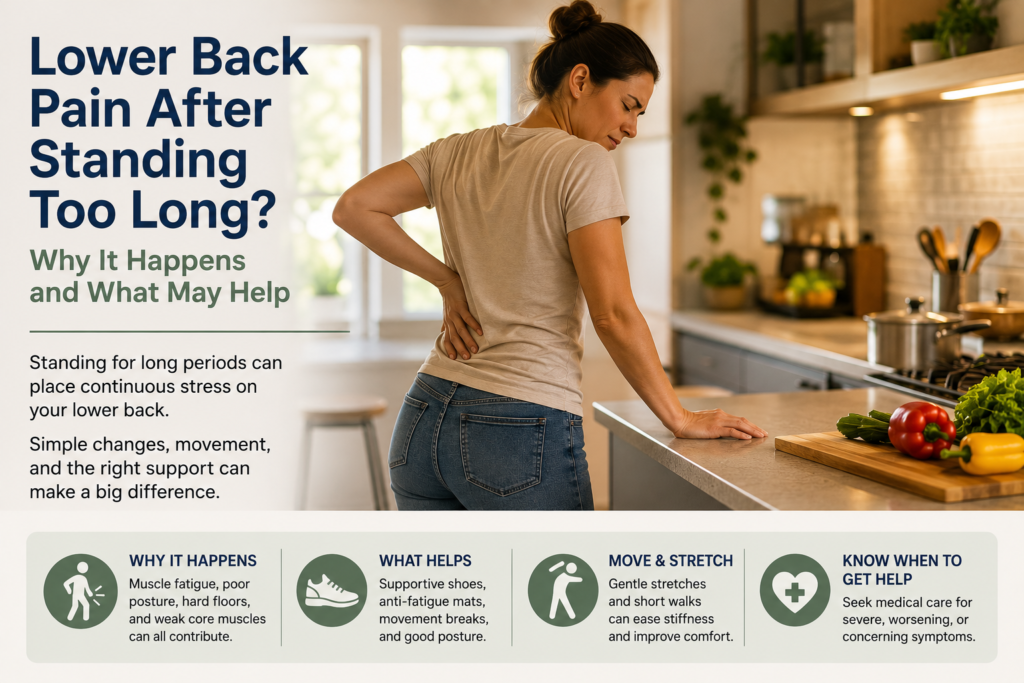
Lower back pain after standing too long? Learn why prolonged standing can become uncomfortable and discover practical ways to move, adjust your environment, and find relief.
Have you ever spent hours cooking, shopping, working a shift, attending an event, or standing at a counter only to notice your lower back becoming increasingly uncomfortable?
Standing may seem like a simple activity, but remaining in one position for a long time can become tiring.
Your muscles continuously make small adjustments to keep you balanced and upright. As time passes, you may notice aching, stiffness, heaviness, or the urge to sit down or start moving.
That doesn’t necessarily mean you’ve injured your back.
And it doesn’t mean standing is “bad” for you.
For many people, the more useful approach is to change positions regularly, move when possible, make the environment more comfortable, and pay attention to symptoms that deserve medical evaluation.
This guide explains why prolonged standing may aggravate lower-back discomfort and what you can realistically do about it.
Key Takeaways
- Standing isn’t inherently bad for your back.
- Remaining in one position for a long time may become uncomfortable.
- Alternating between standing, sitting, walking, and other positions can provide useful variety.
- Supportive footwear and a more comfortable standing surface may help some people.
- Gentle movement may feel better than remaining completely still.
- You don’t need to maintain one “perfect” standing posture all day.
- Persistent, severe, worsening, or neurologic symptoms should be evaluated by a healthcare professional.
Why Can Your Lower Back Hurt After Standing Too Long?
There’s no single explanation that applies to everyone.
Standing requires your body to continuously maintain balance and support your weight.
Normally, you don’t even notice this happening.
But after you’ve been standing in roughly the same position for a long period, you may start shifting your weight, leaning against something, locking your knees, arching your back, or constantly searching for a more comfortable position.
That’s your body asking for variety.
The discomfort you experience may be influenced by several factors, including:
- How long you’ve been standing
- How much you’re moving
- Your footwear
- The surface beneath you
- Your physical activity and conditioning
- Your work demands
- An existing back problem
- Your individual comfort and health
Instead of assuming one specific muscle or posture is responsible, look for patterns in when your discomfort starts and what makes it feel better or worse.
Standing Still and Walking Aren’t the Same Thing
This is an important distinction.
You might be able to walk around a store comfortably for an hour but feel uncomfortable after standing at a kitchen counter for 30 minutes.
Why?
Walking continuously changes how your body is positioned and loaded.
Standing relatively still gives you much less variation.
That’s why someone who works at a cash register, salon station, laboratory bench, assembly line, or standing desk may experience a different type of fatigue than someone who spends the same amount of time walking.
If you’re required to stand for work, look for safe opportunities to shift position and move, rather than trying to remain perfectly still.
You Don’t Need Perfect Standing Posture
Posture advice often makes standing sound incredibly complicated:
Shoulders back.
Stomach tight.
Chest up.
Feet perfectly aligned.
Don’t move.
Trying to maintain a rigid “perfect” posture for hours isn’t realistic.
Instead, aim for a position that feels comfortable and relaxed.
You may find it helpful to:
- Avoid deliberately locking your knees
- Keep your shoulders relaxed
- Let your arms rest naturally
- Change which position feels comfortable
- Avoid repeatedly leaning heavily toward one side
- Move when your body begins feeling stiff
And remember that changing positions isn’t evidence of poor posture.
It’s normal to move.
Why Standing on Hard Floors Can Feel Uncomfortable
The surface underneath you can affect how standing feels.
If you work for hours on concrete, tile, or another hard floor, your feet and legs may become tired.
As fatigue builds, you may find yourself shifting positions more frequently or changing the way you stand.
This doesn’t mean that impact is literally traveling up your body and damaging your back.
Rather, the overall experience of standing may simply become less comfortable.
Depending on your workplace, supportive footwear or an appropriate anti-fatigue mat may make prolonged standing more comfortable.
Your Shoes Can Matter
If you spend much of your day on your feet, footwear deserves attention.
The best shoe isn’t necessarily the one with the most cushioning or the highest price tag.
Look for shoes that:
- Fit properly
- Feel comfortable
- Are appropriate for your work environment
- Provide adequate room for your feet
- Feel stable while standing and walking
- Aren’t excessively worn down
If your job has specific safety requirements, such as slip-resistant or protective footwear, those requirements should take priority.
If you’re experiencing persistent foot, leg, or back symptoms, a healthcare professional can help determine whether footwear is actually contributing.
Try Changing Positions Before Pain Builds Up
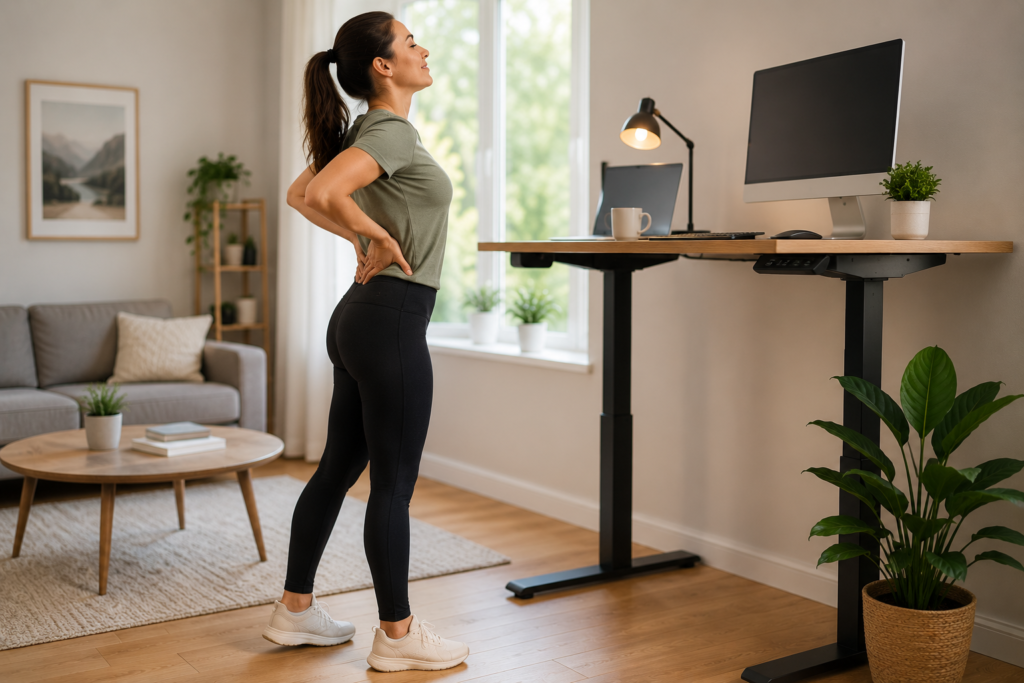
You don’t need to wait until your lower back is extremely uncomfortable before moving.
Look for natural opportunities throughout your day.
For example:
- Take several steps when your work allows.
- Shift your stance.
- Sit briefly during an appropriate break.
- Walk during lunch.
- Change tasks when possible.
- Move your feet rather than standing completely still.
- Alternate between sitting and standing if your workstation permits it.
There isn’t one universal rule saying everyone must move exactly every 20 or 30 minutes.
Your job, abilities, health, and symptoms are different from someone else’s.
The goal is simply to avoid spending unnecessarily long periods frozen in one position.
Can an Anti-Fatigue Mat Help?
If you regularly stand in one location, such as at a standing desk, kitchen counter, workbench, or workstation, an anti-fatigue mat may make the surface feel more comfortable.
The usefulness of a mat will depend on the environment and the individual.
Choose one that:
- Lies securely on the floor
- Doesn’t create a tripping hazard
- Is appropriate for the workplace
- Provides comfortable cushioning without feeling unstable
- Is easy to keep clean
An anti-fatigue mat should be viewed as a comfort tool, not a treatment for unexplained back pain.
What Should You Do When Your Back Starts Aching?
If your symptoms are mild and you’re able to move normally, start simply.
Change Position
If you’ve been standing, sit down briefly or begin walking.
If you’ve been leaning against one side, change your stance.
Sometimes your body simply wants a different position.
Take a Comfortable Walk
If walking feels good, moving around for a few minutes can give your body a break from stationary standing.
You don’t need to walk quickly or turn it into exercise.
Try Gentle Movement
Some people find gentle mobility comfortable after prolonged standing.
The key word is gentle.
Avoid aggressively stretching because you believe you need to force a tight muscle to release.
Stop any movement that causes sharp, severe, or worsening pain.
What About Stretching?
The original version of this article prescribed several stretches with specific hold times and repetition counts.
We’re simplifying that.
Exercises aren’t automatically appropriate for every reader with back pain.
If you’re otherwise healthy and gentle stretching feels comfortable, you might enjoy movements involving your hips, legs, and back.
But you don’t need to force yourself through a specific routine just because you’ve been standing.
A physical therapist or other qualified healthcare professional can recommend exercises based on your symptoms, mobility, medical history, and goals.
Does Core Strength Matter?
Your trunk muscles play an important role in movement and physical activity.
But it’s overly simplistic to say:
“Your back hurts because your core is weak.”
Back pain can have many contributing factors.
General strengthening and physical activity may be useful components of an overall healthy lifestyle, but doing abdominal exercises isn’t a guaranteed cure for standing-related back pain.
If you want to begin strength training, start at an appropriate level and gradually progress.
People dealing with persistent pain or medical conditions may benefit from individualized professional guidance.
Sitting Isn’t the Enemy Either
Here’s where things get interesting.
We’ve talked about how prolonged sitting can become uncomfortable.
Now we’re talking about prolonged standing becoming uncomfortable.
So which one is better?
For many people, the answer isn’t sitting versus standing.
It’s variation.
Your day might include:
Sitting → standing → walking → sitting → moving → standing.
You don’t need to spend eight hours in any one position to prove it’s the healthiest option.
If sitting also bothers your back, read:
Why Lower Back Pain Gets Worse After Sitting
Using a Standing Desk Without Overdoing It
A sit-stand desk can be useful because it provides another working position.
But buying one doesn’t mean you should suddenly stand through your entire workday.
If you’re accustomed to sitting most of the day, gradually experiment with different positions.
Use the desk to create variety.
Stand for a while when comfortable.
Sit when you want to sit.
Walk when you have an opportunity.
Your desk is a tool—not a posture test.
Can Heat Help After Standing All Day?
Some people find gentle warmth soothing when their lower back feels stiff or achy after a long day.
A heating pad may provide temporary comfort for muscle tightness.
However, heat isn’t appropriate for every situation, and hotter or longer isn’t necessarily better.
Follow the manufacturer’s instructions for your device and monitor your skin.
We’ve created a separate guide covering this in detail:
Can You Use a Heating Pad Too Much?
That article explains heating-pad safety, common mistakes, and signs that you may be overdoing heat.
Your After-Work Routine Doesn’t Need to Be Complicated
After spending an entire shift on your feet, you may be tempted to follow an elaborate recovery routine.
Start with what feels comfortable.
You might:
- Change into comfortable shoes
- Walk gently
- Sit and rest
- Change positions
- Use gentle warmth when appropriate
- Perform comfortable mobility
- Get adequate sleep
Pay attention to what actually helps you rather than assuming every internet back-pain routine needs to become part of your day.
Think About Your Entire Work Environment
If standing is part of your job, look beyond your back.
Ask yourself:
Is the counter at an awkward height?
Are you constantly twisting toward one side?
Do your shoes feel comfortable halfway through your shift?
Are you standing on a very hard surface?
Can you safely change positions?
Are breaks available?
Do you have to repeatedly lift or reach?
Sometimes improving the environment can be more useful than repeatedly trying to “correct” your posture.
If Both Sitting and Standing Hurt
Some people find that sitting hurts.
Then they stand—and eventually standing hurts too.
That doesn’t necessarily mean you’re doing everything wrong.
It may simply mean that your back currently doesn’t tolerate prolonged static positions particularly well.
Try incorporating more variety and appropriate movement.
If your symptoms continue despite reasonable changes, that’s a good reason to speak with a healthcare professional rather than endlessly adjusting your chair or shoes.
Morning Pain Can Provide Another Clue
If your back hurts after standing all day and you regularly wake up stiff or uncomfortable, your symptoms aren’t limited to standing.
That broader pattern may be worth discussing with a healthcare professional if it persists.
You can also read:
Why Lower Back Pain Is Worse in the Morning
This explains some of the reasons people notice a different pattern of discomfort after sleeping.
When Lower Back Pain Needs Medical Attention
Don’t automatically attribute every episode of lower-back pain to standing.
Seek urgent medical attention for back pain accompanied by symptoms such as:
- New loss of bowel or bladder control
- Numbness around the groin or saddle area
- Significant or worsening weakness
- Severe symptoms following a major fall, collision, or injury
You should also consider medical evaluation when pain:
- Is severe or progressively worsening
- Persists rather than improving
- Regularly interferes with work, sleep, or daily life
- Travels into a leg, particularly with weakness or numbness
- Occurs with fever or feeling seriously unwell
- Is unexplained or concerning to you
Your individual symptoms and medical history matter.
Frequently Asked Questions
Is it normal for my lower back to ache after standing all day?
It’s not unusual for people to experience discomfort or fatigue after prolonged standing, but back pain has many possible causes. Persistent or worsening symptoms shouldn’t automatically be blamed on standing.
Is standing better for your back than sitting?
Neither position is automatically superior in every situation. Prolonged sitting and prolonged standing can both become uncomfortable. Changing positions and moving throughout the day may be more practical.
How often should I take a break from standing?
There isn’t one required interval that applies to everyone. Look for realistic opportunities to sit, walk, or change positions during your day, particularly when you begin feeling uncomfortable.
Can better shoes help?
Comfortable, properly fitting footwear may make long periods on your feet more comfortable. If symptoms persist despite changing footwear, consider whether another factor may be contributing.
Can I use a heating pad after standing all day?
Some people find gentle heat comfortable for muscle stiffness. Follow your heating pad’s instructions and avoid excessive temperatures or prolonged exposure.
Should I stretch my back after work?
Gentle movement or stretching may feel comfortable for some people, but exercises shouldn’t cause sharp or worsening pain. If you’re unsure what movements are appropriate for your symptoms, seek professional guidance.
Final Thoughts
Lower-back discomfort after standing for a long time doesn’t necessarily mean standing is damaging your spine.
Often, the more useful question is:
How much variety does your body get during the day?
Instead of trying to stand perfectly for hours, look for opportunities to move, walk, sit, change your stance, and make your environment more comfortable.
Supportive footwear or an anti-fatigue mat may help some people, but no product can diagnose or solve every cause of back pain.
Pay attention to your symptoms.
If simple changes improve your comfort, keep building those habits into your day.
If your pain persists, worsens, or comes with concerning symptoms, seek professional medical care rather than continuing to treat it as ordinary standing fatigue.
PathwayToRelief.com may contain affiliate links. If you purchase through one of these links, we may earn a commission at no additional cost to you. Product mentions are provided for informational purposes and should not be considered medical recommendations.
PathwayToRelief.com provides general educational and wellness information only. This article is not intended to diagnose, treat, cure, or prevent any medical condition and is not a substitute for individualized medical advice, diagnosis, or treatment from a qualified healthcare professional. Seek appropriate medical care for severe, persistent, worsening, or concerning symptoms.